Independent operator. Six years founding and running things; highlights include a SaaS company, a fintech platform and a concentrated equity book with its own in-house research stack. Looking to join a team.
I run a concentrated, fundamental, thesis-driven equity book with a macro overlay across rates, FX, and commodities. I publish some full writeups at cypruspoint.substack.com.
After graduating at the top of my class at the University of Toronto, I was writing production code, fully self-taught, before AI assistants existed (full-stack, solo, in React and Python and Node and SQL), and that craft is the substrate underneath everything else I've built. The investment process and the software that supports it are the same discipline expressed in different tools.
The path here was non-linear; hard work and impermanence are inevitable. At twenty I co-founded a SaaS company focused on an underlying platform for building custom mobile apps for SMBs. At twenty-three, drawn intellectually to economic & statistical research, I shipped a fintech platform solo that explored stochastic discounted cash flow valuation. At twenty-four, building off prior research, I started the book and built the in-house research stack to run it. The thread runs through all of it: independent operator with breadth who makes and runs real things.
I'm looking to join a team. A senior operator I can learn from would matter more than the prestige of the seat.
A capital-preservation-oriented book across US and Canadian equities, commodities, options, rates, and FX. Typically 20–40% cash; only deploy on high-conviction setups. The analytical infrastructure beneath it is mine, following a process of thesis, market confirmation, and size; a Druckenmiller-influenced second-derivative ROC macro-regime framework over ~90 instruments, supplemented with factor flows, and an options-flow pipeline using Lee-Ready and OPRA codes. See §04 for how those work.
The regime work surfaces a rough market gameboard: where liquidity is flowing and what that flow says. Independent markets in agreement with one another are not noise; they are a temporary equilibrium information flow. Capital deployment is then conditional on this information set.
I orchestrate all of this information through an in-house multi-agent research platform built on a Python/Flask backend and React frontend, which uses multi-model LLM routing as a multi-step harness; fundamental idea generation and synthesis run through an equity-screening pipeline with explicit inter-agent disagreement protocols. The disagreement is the output. So is consensus. As a consequence, equities that warrant deeper analysis already pass standard gating criteria.
Coverage: equities (US and Canada, all caps); index and single-name options; Treasuries and TIPS; G10 FX; commodities; merger arbitrage.
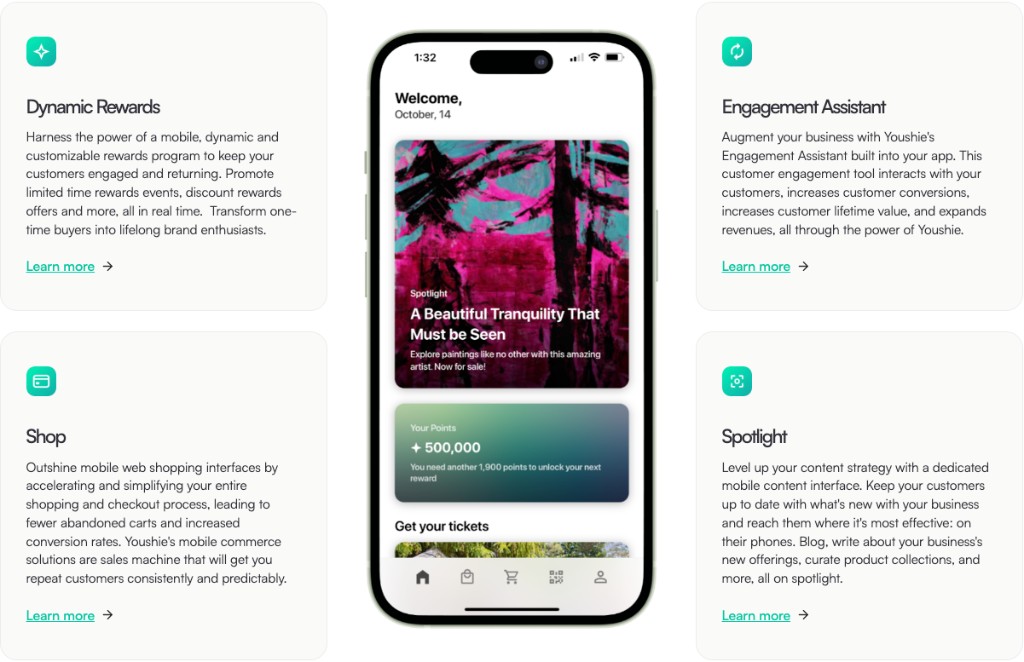
Co-founded an e-commerce SaaS delivering custom-branded native mobile apps (iOS / Android) to small-and-medium-sized merchants: mobile shop, dynamic rewards, an automated engagement assistant, and Spotlight for in-app content. Delivered as a managed platform merchants could launch without hiring an agency. Integrations with Shopify, Square, Stripe, Moneris, and Mailchimp met merchants where their operations already lived.
Led front-end architecture in React Native and React within a full-stack Node.js / MariaDB environment. The work was end-to-end: merchant onboarding (sign up, configure, submit to App Store and Play Store), operator dashboards, and the customer-facing surfaces inside each branded app. Multi-year run with B2B clients — record shops, wineries, arts retailers — where repeat purchase and retention were the metrics that mattered, not vanity installs.
This is where I learned to ship production software with paying customers: scoping features against what moved retention, managing client outreach & acquisition, fixing broken checkouts on short notice, and building for non-technical operators who needed the product to work without a manual. Everything since (fintech, the book, multi-agent research) builds on that foundation.
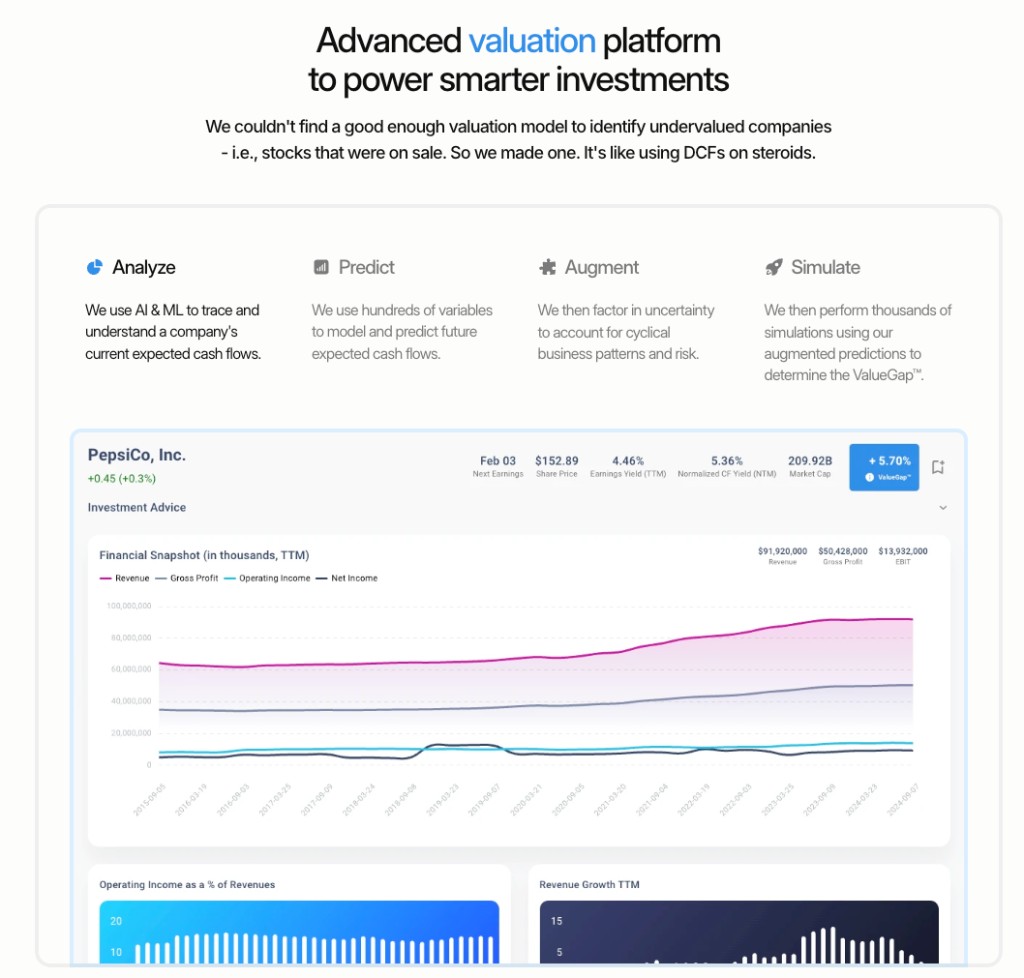
Full-stack solo build. React frontend, R for quantitative modelling, Node.js backend, MariaDB. Built proprietary stochastic valuation models and AI-driven SEC filing summarization tools. Active but not actively commercialized; analytical methodology now runs internally in support of CyprusPoint.
Writing production code for six years, both solo and full-stack. The craft is genuinely mine. AI tooling makes me faster now, but it didn't teach me how to think about systems or debug a pipeline at 2 a.m. That part was earned.
To me, one of investing's best track records is a function of timing inflection points into expanding issue liquidity. SROC is the technical expression of that: the rate of change of the rate of change. When the second derivative crosses zero, momentum is decelerating even if price is still rising. Combining this information across asset classes and timeframes, macro regimes begin to surface.
I track ~90 macro and equity instruments. Per-signal z-score normalization so a 0.5 σ move in copper is comparable to a 0.5 σ move in 10s. Most days, the screen is noise. One or two crossings or changes a month carry information. The discipline is treating the screen as a question generator, not an answer.
The key to winning is the ability to operate on fundamental realities just as well as, if not better than, the masses, with a keen sense for macro flows, cycles, and extracting information from market price action; too many conventional investors focus solely on what they perceive as true fundamentals, ignoring the reality over which price movements act as a noisy filter on humanity's best guess.
If you wish to draft the best in the NFL, you follow what is known as the consensus big-board (think of this as a large average over individual participant rankings); why do we convince ourselves markets are different?
The ego is a dangerous ally; the second you start thinking you know more, you are in trouble. I have found that little is lost, and consequently much is to gain, by treating price action as a genuine, primal embodiment of information regarding markets. Asking yourself why prices are moving in such a way, and what must be true conditioned on multi-asset moves is the source of outperformance in the short-term.
Establish a thesis on fundamental reality, or as close as we can estimate it, look to markets for confirmation of that thesis, size up into accelerating momentum, and exit on decelerating returns when valuation is no longer favourable.
A 15 bps move in 10s can be growth / rate expectations, inflation, or term premium, or fiscal supply; each carries materially different cross-asset implications. Reading the headline yield without decomposing it is reading the verb without knowing the subject. Many major market inflection points are those that appear strongly both in equities and bonds.
The pipeline I built decomposes daily TIPS moves into duration, inflation, and term-premium drivers, with 5Y5Y forwards and breakevens layered on top. When the market reads "rates up = bad" but the move is demand-driven bids on the real rate, you find yourself on the right side of cross-asset trades that the consensus is mispricing. Similarly, retreating yields are likely bearish if driven solely by inflation expectations; in that case, rising nominal yields are actually a bull signal. This dynamic played out during the 2026 Iran war.
I publish full investment writeups at cypruspoint.substack.com. Three to start with.
Asymmetry as the actual game. A turnaround thesis on a name the market is still pricing for past missteps — debt paid down, litigation cleared, pipeline real — wrapped in the opening philosophy that anchors everything else I write.
Canadian cannabis is not one industry. It's two structurally different games being played under the same regulatory umbrella, and brand equity is the only durable source of competitive advantage in the regime that matters.
A pre-financing inflection where decades of underinvestment in North American salt supply meet inelastic, government-mandated demand. NAV re-rates on a single debt-financing event.
Trying to replace labor one-for-one with AI is working from an idealistic premise. LLMs are exceptional imitators, but imitation is not reasoning. The better question is: what would a workflow look like if it were designed around stochastic, language-imitative behavior from the start? It then follows that human intervention should be placed deliberately at the points where reason and judgment actually live, leaving agentic operations to repetitive tasks that maintain low cognitive effort. That's a different architecture than "human task, but cheaper." It's a redesign of where reason gets applied and where imitation is enough. Most of the value I've found in building agent systems is in answering where judgment, reasoning, and intuition actually drive results for a specific workflow: identify the cognitive bottleneck and build a pipeline around it to facilitate faster decision-making.
What Druckenmiller, Kovner, Lipschutz, and Dennis (and the Turtles) were really doing brings their unique approaches into one common thread of wisdom. Each converged on a different answer to the same question of how to win in markets, yet all spoke in a similar vein regarding the market itself. How can one properly interpret financial noise into actionable insights for one's investing arena? I've learned investing is a game, and one cannot be rigid in idealism or pragmatism; markets are information — treat them as such.
Where attention, ego, agency, and information processing meet, and what that says about how we think. The good investors I've read about all describe themselves as the agent of their doing, with a specific wisdom seldom observed in other occupations.
The next iteration of agentic workflows: memory architecture (e.g. Zep, Mem0), agent orchestration (LangGraph, CrewAI), and the open question of how to organise AI agents both vertically and horizontally to minimise stochastic inaccuracies. LLMs are great imitators — yet how should agentic workflows be written to maximise this ability to imitate while preserving human-led agency and a genuine ability to reason?
If you're building something serious, or you know a team where I'd be a fit, I'd like to hear from you.
stephendaddario@outlook.com